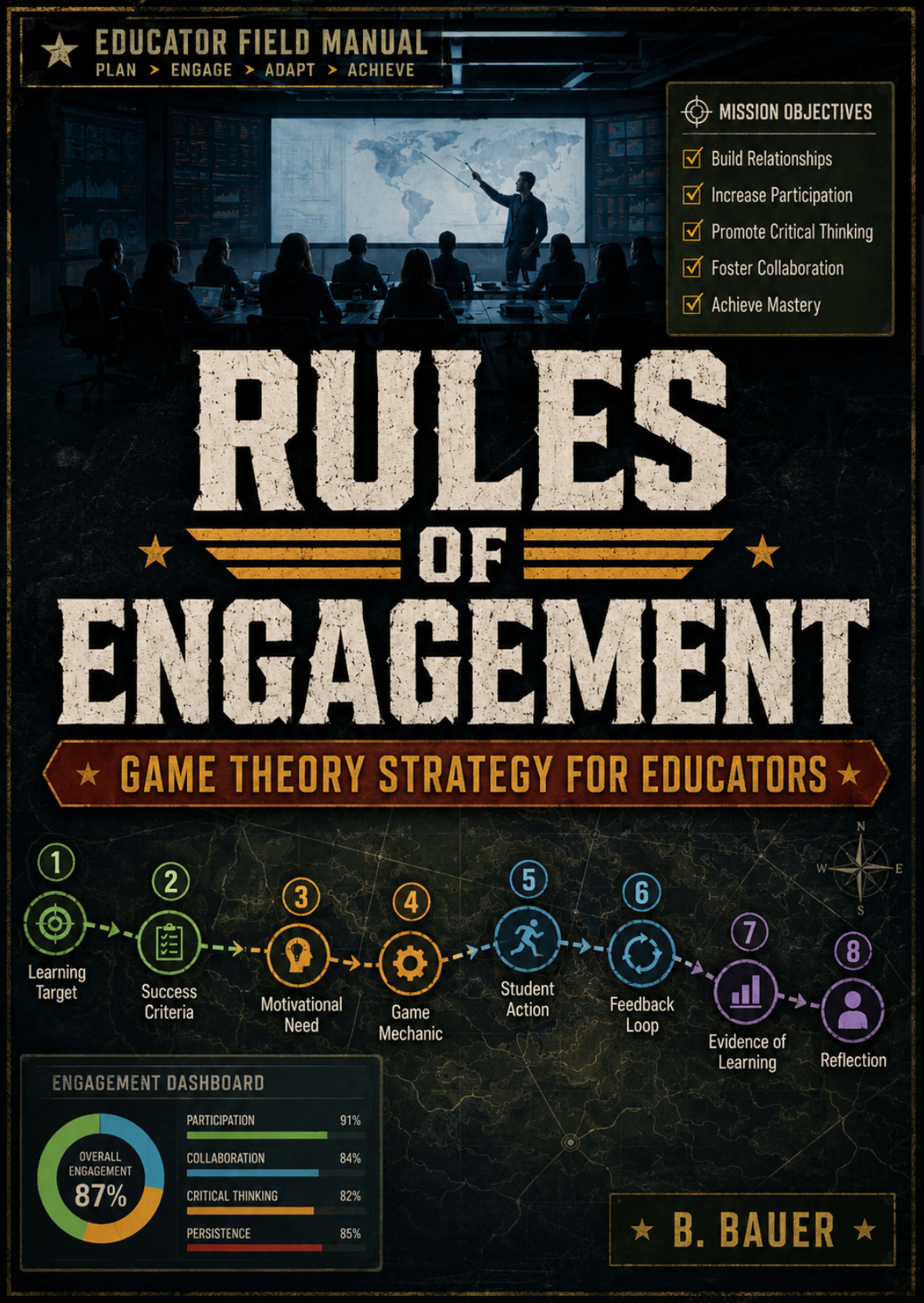
Rules of Engagement: Game Theory Strategy for Educators helps teachers look beyond compliance and rethink why students choose to participate, persist, or check out. Drawing from motivation research, classroom experience, and game-design principles, the book offers practical ways to create clearer goals, meaningful choices, visible progress, stronger feedback, and safer opportunities for students to take academic risks. It is designed for educators who want realistic, low-prep strategies they can use to make learning feel more purposeful and engaging.
Empowering Education Through Game Theory and Discovery
Bring Rules of Engagement to your school or district through practical professional learning designed for real classrooms. These sessions help educators better understand why students disengage and how small shifts in clarity, choice, feedback, progress, and classroom incentives can lead to stronger participation. Whether it is a staff meeting, workshop, PLC session, or half-day training, participants leave with useful tools and ideas they can apply right away.


Brandon Bauer is a Missouri educator with over a decade of experience serving students across K–8 settings, including special education and social-emotional learning classrooms. His work is grounded in helping students who often feel disconnected from traditional school systems find clearer paths to participation, progress, and success.
With a background in educational leadership and instructional technology, Bauer brings together classroom experience, practical systems thinking, and a focus on teacher-friendly solutions. He is the author of Rules of Engagement: Game Theory Strategy for Educators, a guide for educators who want to build more motivating, purposeful, and engaging learning experiences.
Find the Path, Lead the Way
The Problem:
Too many students are disengaging from school—not always because they cannot do the work, but because learning can feel unclear, repetitive, risky, disconnected, or impossible to win. When students do not understand the goal, cannot see their progress, receive feedback too slowly, or feel that failure will embarrass them, opting out can become the most logical choice. Teachers are often asked to solve this with more incentives, more consequences, or more energy, even when the real issue is the design of the learning experience itself.
The Solution:
Rules of Engagement helps educators design learning experiences that give students clearer reasons to participate. Using practical ideas from motivation research, game theory, and classroom experience, the framework guides teachers through eight connected steps: identifying the learning target, defining success criteria, recognizing the motivational need, choosing an appropriate game mechanic, planning student action, creating a feedback loop, gathering evidence of learning, and building in reflection. The result is not a classroom built on gimmicks or prizes. It is one where students can understand the goal, see a path forward, and believe their effort matters.
-
A focused, practical introduction that helps teachers understand why students disengage and identify small changes they can make immediately.
-
A deeper, hands-on session where participants use the engagement framework to examine and improve a lesson, routine, or classroom system.
-
An extended professional-learning experience that gives teams time to explore the eight-step framework, collaborate, and build an actionable engagement plan.